
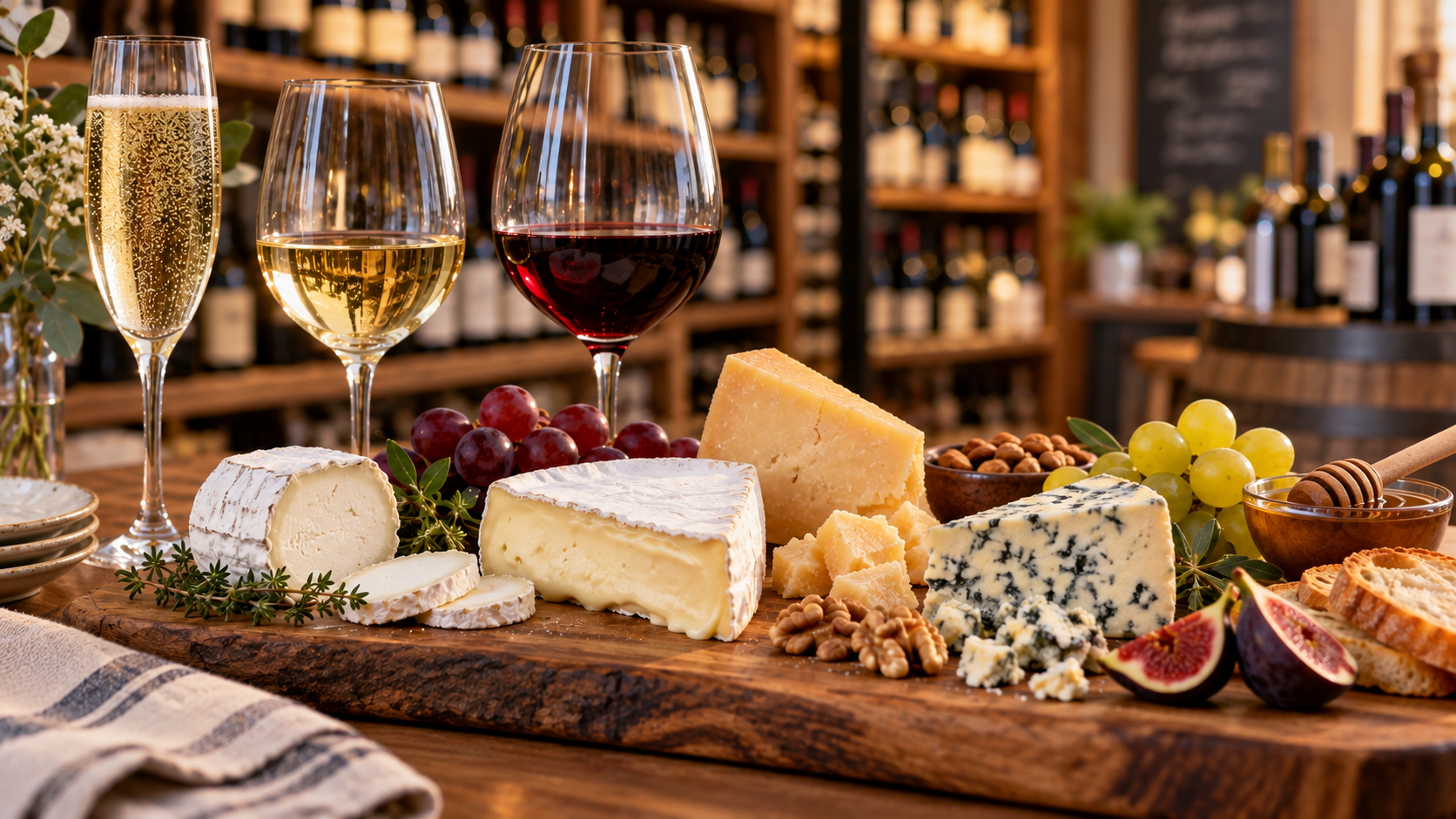
Peanut butter and jelly. Ernie and Bert. Some things belong together. Like wine and cheese.
Wine and cheese are one of the world’s most iconic food pairings. They’ve been enjoyed together for centuries, they appear at everything from casual gatherings to posh dinner parties, and somehow they always seem to make each other taste better.
But if you’ve ever stood in front of a cheese counter wondering whether your bottle of Chardonnay belongs with Brie, Gouda, or something else, you’re not alone.
The good news is that pairing wine and cheese is much simpler than many people think. You don’t need to be a sommelier. Or a cheesemonger. Once you understand a few basic principles, you’ll be able to pair with confidence.
Why Wine and Cheese Work So Well Together
Wine and cheese are natural partners because they can balance each other.
Cheese has fat, protein, salt, and often a creamy texture that coats your palate. Wine has acidity, fruit flavors, tannins (sometimes), sweetness (sometimes), and freshness. When paired well, each helps highlight the best qualities of the other.
Think of squeezing a lemon on salmon. The acid from the lemon brightens the fish and keeps it from feeling heavy. Wine does something similar with cheese, refreshing your palate between bites and making you want to take another sip.
The goal isn’t to find a perfect pairing, but rather to find combinations where each complements the other and neither the wine nor the cheese overwhelms the other.
Principle #1: Match Intensity with Intensity
This is probably the most important principle. Light wines go with light cheeses. Bold wines go with bold cheeses. A delicate goat cheese can be overwhelmed by a powerful Cabernet Sauvignon, while a strong aged cheese can overpower a light Pinot Grigio.
A few great pairings that follow this principle:
- Fresh goat cheese with Sauvignon Blanc
- Brie with Chardonnay
- Aged cheddar with Cabernet Sauvignon
It’s like a Tony Bennett/Lady Gaga duet: When the intensity of both the wine and cheese are similar, each gets a chance to shine.
Principle #2: Don’t Automatically Reach for Red Wine
One of the biggest mistakes in pairing wine and cheese is the assumption that cheese always belongs with red wine, when in reality, white wine is often the better choice.
Many cheeses are rich and creamy. White wines tend to have higher acidity, which cuts through that richness and refreshes your palate. Red wines, especially high-tannin reds, can sometimes clash with cheese and taste bitter.
That isn’t to say red wine never works. It certainly does. But if you’re building a cheese board and aren’t sure which wines to choose, consider serving:
- Sauvignon Blanc
- Chardonnay
- Riesling
- Sparkling wine
You might be surprised at how versatile they are.
Principle #3: Embrace the Acid
Acid is one of the most important components of a successful wine and cheese pairing.
Imagine eating a rich triple-cream Brie. Without something to balance it, that richness can feel heavy after a couple bites. But add a crisp sparkling wine and suddenly the combination feels balanced and fresh. This is one reason why sparkling wine is often considered a safe choice for a cheese board. The acid and bubbles act like a palate cleanser between bites.
But don’t forget other high-acid wines like Sauvignon Blanc and Riesling that also cut through rich, creamy cheeses.
Principle #4: Salty Loves Sweet
While you want to match intensity (Principle #1), the contrast of saltiness and sweetness can result in a beautifully-balanced pairing.
Classic examples include:
- Port with Stilton
- Sauternes with Roquefort
- Late-harvest Riesling with blue cheese
This combination (salty with sweet) might sound unusual at first, but if you’ve ever eaten a chocolate-covered pretzel, you know what I mean.
Understanding the Major Cheese Categories
There’s no need to memorize pairings for hundreds of cheeses. It’s much easier to think about a few broad categories.
Fresh Cheeses
These are typically light, delicate, and tangy. Examples include:
- Goat cheese/chevre
- Ricotta
- Mozzarella
- Burrata
Good matches for these will have bright acidity to complement the freshness of the cheese without overpowering it. Try wines like:
- Sauvignon Blanc
- Albariño
- Sparkling wine
- Dry Rosè
Soft, Creamy Cheeses
These are rich, buttery, and luxurious. Examples include:
- Brie
- Triple-cream cheeses
- Camembert
Again, you’ll want higher-acid wines to cut through the creaminess:
- Champagne or Sparkling wine
- Unoaked Chardonnay
- Pinot Noir
Semi-Firm and Nutty Cheeses
These tend to have richer flavors, especially nutty and buttery flavors. Examples include:
- Gouda
- Gruyère
- Havarti
Because of the flavor intensity of these cheeses, they can stand up to a wider variety of wines. Consider:
- Chardonnay (oaked or unoaked)
- Pinot Noir
- Beaujolais
- Rhône blends
Hard, Aged Cheeses
Aging concentrates the flavors and often increases the saltiness. Examples include:
- Aged Cheddar
- Manchego
- Parmigiano-Reggiano
- Pecorino
To complement these you’ll want wines with more structure and tannins that will match the fat and protein in the aged cheeses. Wines like:
- Chianti
- Barolo
- Cabernet Sauvignon
- Syrah
Blue Cheeses
These are intense, salty, and sometimes pungent. Examples include:
- Stilton
- Roquefort
- Gorgonzola
Keeping in mind our “Salty Loves Sweet” principle, sweet wines will pair well with blue cheeses. So look for:
- Port
- Sauternes
- Late-harvest Riesling
A Helpful Hint: What Grows Together, Goes Together
In many wine regions, local wines and local cheeses evolved alongside one another. As a result, they usually pair well.
A few examples include:
- Chianti with Pecorino
- Rioja with Manchego
- Loire Valley Sauvignon Blanc with French goat cheese
The Most Important Principle of All
Wine people sometimes make pairing seem more complicated than it needs to be. Sure, understanding texture, acidity, tannin, and sweetness can help us make better pairing choices. But ultimately, wine and cheese are meant to be enjoyed.
If science says a particular pairing shouldn’t work but it still tastes great to you, then that is a successful pairing.
So start with the basic principles. And then feel free to experiment.
Some of the best wine and cheese pairings happen when you stop worrying about the rules and simply start tasting!
Never miss a post! If you found this blog post helpful, scroll down and subscribe. You’ll get a notification every time (about every five days or so) a new blog post is published. Thanks for reading!



Leave a Reply