
I remember my teenage years in the 1980s when my mom would have a box of Beringer White Zinfandel in the refrigerator at all times. It probably wasn’t something she would order in a restaurant, but it was an inexpensive, not great but drinkable alternative to have in the house for everyday drinking.
A general shift in wine consumption in the United States began to occur in the 1990s as wine drinkers started paying more attention to things like point scores, wine publications, and wine critics. The general public became a bit more educated about grapes and wine producing regions. This led to a focus on higher-quality wines. With this “trading up,” boxed wine began to get the reputation for being cheap, mass-produced, and lower quality.
A lot has changed since then. Boxed wine has come into its own. So here are four reasons why you should be drinking boxed wine.
#1: Improved Quality
Boxed wine isn’t what it used to be. Say goodbye to the cheap bulk-produced boxed wines of yesterday and hello to the high-quality, respected producers of today. The quality of boxed wine has improved dramatically over the past 20 years as more producers have explored alternative packaging (boxes, cans, tetrapaks.)
As consumers started to embrace this alternative packaging and created a larger market for them, producers needed to put better quality wine in boxes to maintain or grow their competitive advantage.
#2: Longer Lasting
With the typical box holding 3 litres (the equivalent of four bottles), you’ll want it to last a while unless you’ve got plenty of wine-drinking friends with you. That’s where the design of the spigot and vacuum-sealed bag come into play. Earlier versions of the bag tended to let in one of wine’s worst enemies: oxygen. Oxidation of the wine led to shorter shelf life.
Improved technology has helped create bags that expose the wine to less oxygen, significantly increasing the length of time the wine will last. Most boxes of wine today will still be drinkable about four weeks after opening. Full disclosure: I have never been able to test this because I finish the box well before four weeks have passed.
This longer shelf life has also enabled producers to put more delicate, higher-quality wines (see #1) in boxes.
#3 Affordability/Value
This is one thing that hasn’t changed in the past 20 years. Boxed wine is generally less expensive than bottled wine of the same quality.
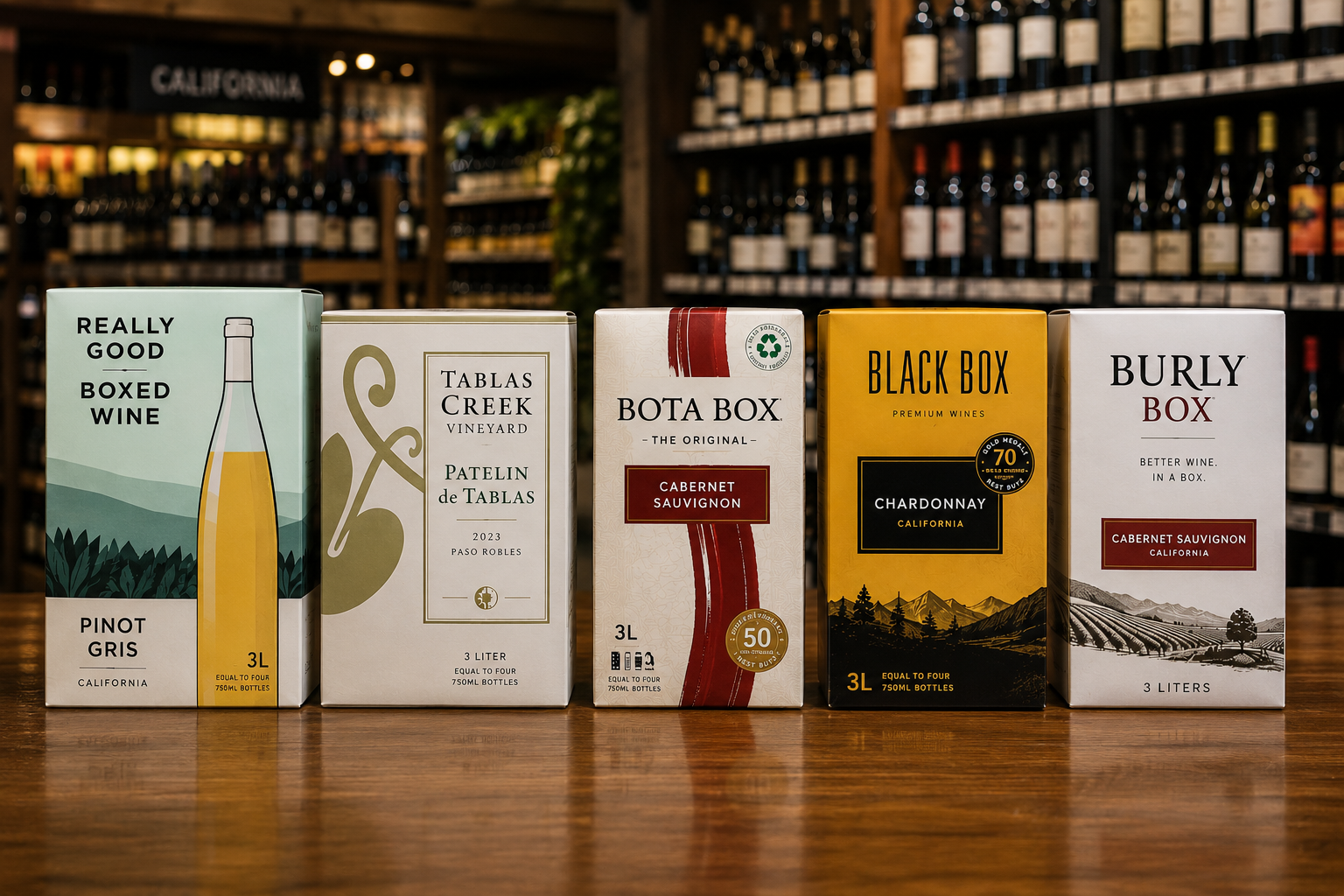
For example, two of the most popular boxed wine brands in the United States – Bota Box and Black Box – retail for roughly $20. With the equivalent of four 750ml bottles per box, that comes to about $5 per bottle!
Why does boxed wine cost so much less? It’s mainly because of the weight of the packaging and transport costs. One cardboard box (plus the inner plastic bag and plastic spigot) weighs much less than four bottles. This means that more wine can be transported per truckload, which results in lower fuel consumption. Lower fuel costs means you pay less at the store.
There are exceptions to the $20-per-box pricing, but these exceptions reflect the entry of premium wine producers into the usage of alternative packaging. One prime example that comes to mind is Tablas Creek Vineyard in Paso Robles, CA. This winery produces excellent Rhone-style wines and is renowned for its commitment to the environment. Tablas Creek offers its popular Patelin de Tablas red, white, and rose in 3L boxes at a list price of $105 each. While that sounds like a lot to pay, the exact same wine in a bottle costs $30, or $120 for the four bottles that would fit in the box.
#4 Environmental Impact
There’s no doubt about it. Boxed wine has a significantly lower environmental impact than bottled wine. Several factors influence this.
Production: Glass production requires much more energy than cardboard because of the extreme heat – and thus the fossil fuels – needed to melt the raw materials that go into it.
Transportation: As noted above, more wine can be transported per truckload, resulting in lower fuel consumption and lower fuel emissions. Some studies have estimated that boxed wine results in roughly 60% lower emissions than bottled wine for the same volume.
Waste: For material that ends up in landfills, boxed wine creates about 80% less landfill waste than bottles.
There is one factor where bottled wine has the advantage, and that is recycling. Glass is completely recyclable and can be recycled over and over again. Cardboard can be recycled but over time the fibers degrade. Furthermore, the plastic spigot and the inside plastic bag cannot be recycled. But the caveat to this caveat is that for glass bottles to have the recycling advantage, they actually need to be recycled.
Now don’t get me wrong. I’m not saying you should only drink boxed wine. You’d be missing out on a lot of fantastic wine if you did. But it’s a great way to enjoy good-quality, long-lasting, affordable, eco-friendlier wine.
Keep the conversation going. What do you think about boxed wine? What’s your favorite?




Leave a Reply