
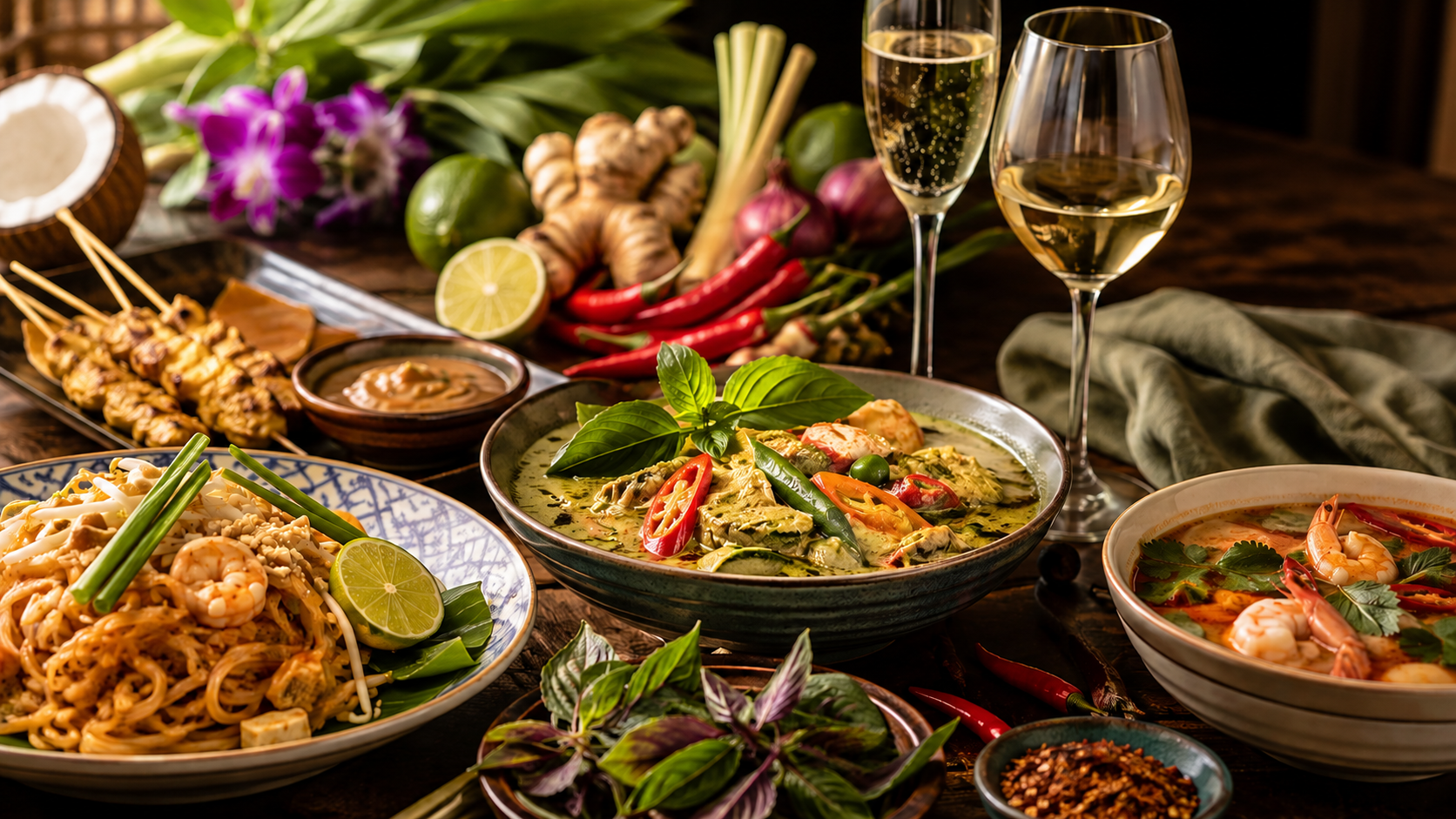
There’s a saying in the wine world: “What grows together goes together.” And this means that wines from a particular region pair well with foods from that same region. But what happens when you’ve got a place like Thailand, whose cuisine is popular throughout the world, but whose total wine production (for the entire country) is comparable to that of just one large California winery?
The right wine and Thai food pairing can produce a beautiful symphonic harmony, while the wrong pairing can result in “fingernails on a chalkboard!” Luckily, pairing wine and Thai food is fairly simple if you follow a few basic rules.
What makes Thai food unique?
Thai cuisine centers around five core flavors:
- Sweet
- Sour
- Salty
- Spicy
- Umami (Umami is a savory, mouth-filling taste that adds richness and depth to food.)
The magic is in the balance. Unlike many cuisines that emphasize one flavor, Thai cuisine balances multiple flavors at one time. Think about Pad Thai’s flavors. It’s got sweet (palm sugar), sour (lime), salty and umami (fish sauce), and varying levels of spiciness (peppers.)
Pad Thai is also a great example when thinking about ingredients. There are common ingredients in Thai cuisine, and these become influential when choosing which wine(s) to pair. They are:
- Lime (sour)
- Fish sauce (salty, umami)
- Chili peppers (spicy)
- Coconut milk (sweet)
- Lemongrass (lightly sweet and sour)
- Thai basil (lightly sweet and spicy)
- Ginger and galangal (spicy)
In addition to the five core flavors, Thai cuisine’s ingredients are characterized by aromatics. Ingredients like lemongrass, Thai basil, ginger, and galangal (which is similar to ginger but has more citrus and pine attributes) contribute distinctive aromas.
Understanding these flavors and aromas is the first step in choosing wines that enhance the food rather than compete with or overwhelm it.
Golden Rules for Pairing Wine with Thai Food
Because of the combination of flavors and aromas, successful wine pairings require a somewhat different approach than pairing with many Western dishes.
Rule #1: Spice loves a little sweetness
We should be afraid of a little sweetness when it comes to wines with Thai food. Off-dry wines like Chenin Blanc or Riesling can help balance the heat from chili peppers.
Rule #2: Acidity is essential
Many Thai dishes have bright, tangy flavors from lime juice or fresh herbs. High-acidity wines like Sauvignon Blanc and Riesling (again) can match that brightness.
Rule #3: Aromatic wines shine
Wines with floral aromas like Gewürztraminer (lavender, rose petals) and Riesling (again!) (jasmine, honeysuckle) can complement the aromas of Thai cuisine rather than compete against them.
Rule #4: Keep alcohol moderate
Alcohol can intensify the spiciness of food and turn the heat of the spice into a bonfire! Once again, an off-dry, lower-alcohol Riesling rises to the top.
The Best Wines for Thai Food
So our goal is to find wines that can handle spice, complement aromatic herbs, and enhance the flavors in Thai dishes. Luckily there are several that fit the bill.
Riesling (the MVP)
Riesling is a terrific food wine. Period. It works especially well with Thai cuisine because of its naturally-high acidity and soft aromatics and crisp fruit flavors. Off-dry Rieslings have that hint of sweetness that can tamp down the spice in Thai dishes.
Gewürztraminer
The floral aromas that are typical of Gewürztraminer can pair beautifully and complement the lemongrass, Thai basil, and galangal in Thai dishes.
Chenin Blanc
Like Riesling, Chenin Blanc offers acidity, fruit-forward flavors, and a bit of sweetness.
Pinot Gris
Pinot Gris is a great choice that doesn’t overpower delicate dishes while enhancing more robust dishes.
Sauvignon Blanc
With vibrant acidity, Sauvignon Blanc matches the bright acidity of dishes with lime and fresh herbs.
Sparkling wine
And don’t forget about the bubbles! Sparkling wine can be a terrific overall food wine. Both the bubbles and the acidity help to cleanse the palate, which is helpful for spicy dishes.
Pinot Noir (the red outlier)
This is one of the few red wine pairings that works well with Thai cuisine. Pinot Noir’s lighter body, softer tannins, and fresh acidity make it an appropriate pairing for heartier Thai dishes with grilled meat.
Pairing Wine with Popular Thai Dishes
The next time you’re having Thai food, try these pairings:
Pad Thai – Riesling or Pinot Gris: Balances sweet, tangy, and savory flavors
Green Curry – off-dry Riesling: Offsets the spice and coconut milk
Red Curry – Gewürztraminer or Chenin Blanc: Complements the richer curry flavors
Tom Yum Soup – Sauvignon Blanc: Matches the dish’s bright acidity
Drunken Noodles – Riesling: Helps tamp down the heat
Massaman Curry – Pinot Noir: The richer texture allows for a wine with more body
Thai Satay – Pinot Gris: Works well with peanut sauce and grilled flavors
But what if I really like red wine?
Traditional big red wines usually struggle when paired with Thai dishes mainly because of two things: alcohol and tannins.
Alcohol’s interaction with spicy food is typically kind of like pouring gasoline on a fire. It amps up the heat. So the higher the alcohol, the hotter that spice is going to feel.
The other culprit – tannins – can have the same effect on spice, making it much more noticeable. But tannins’ interaction with Thai food does another thing. The umami flavor makes the tannins more noticeable, and that can make the wine taste bitter. Yikes!
So it is best to avoid high-alcohol, high-tannin wines like:
- Cabernet Sauvignon
- Nebbiolo wines like Barolo and Barbaresco
- Syrah/Shiraz
- Zinfandel
- Petit Syrah
Your better options for red wine and Thai food are:
- Pinot Noir
- Gamay/Beaujolais
- Lighter-bodied Grenache (Grenache can often be higher in alcohol so check the label or ask the sommelier at the restaurant.)
Thai cuisine really isn’t that difficult to pair with wine when you know the basic rules. Look for wines with a hint of sweetness, bright acidity, expressive aromatics, and low to moderate alcohol.
If you’re truly unsure where to start, reach for an off-dry Riesling. More than any other wine, it will be your safest and most versatile choice.
Ultimately, the best pairing is the one you enjoy the most. I suggest using my recommendations as a starting point and then have fun and experiment to discover your favorite.
Let me know in the comments what wine(s) you like to drink (or what you’re going to try next time) with Thai food.


Leave a Reply