
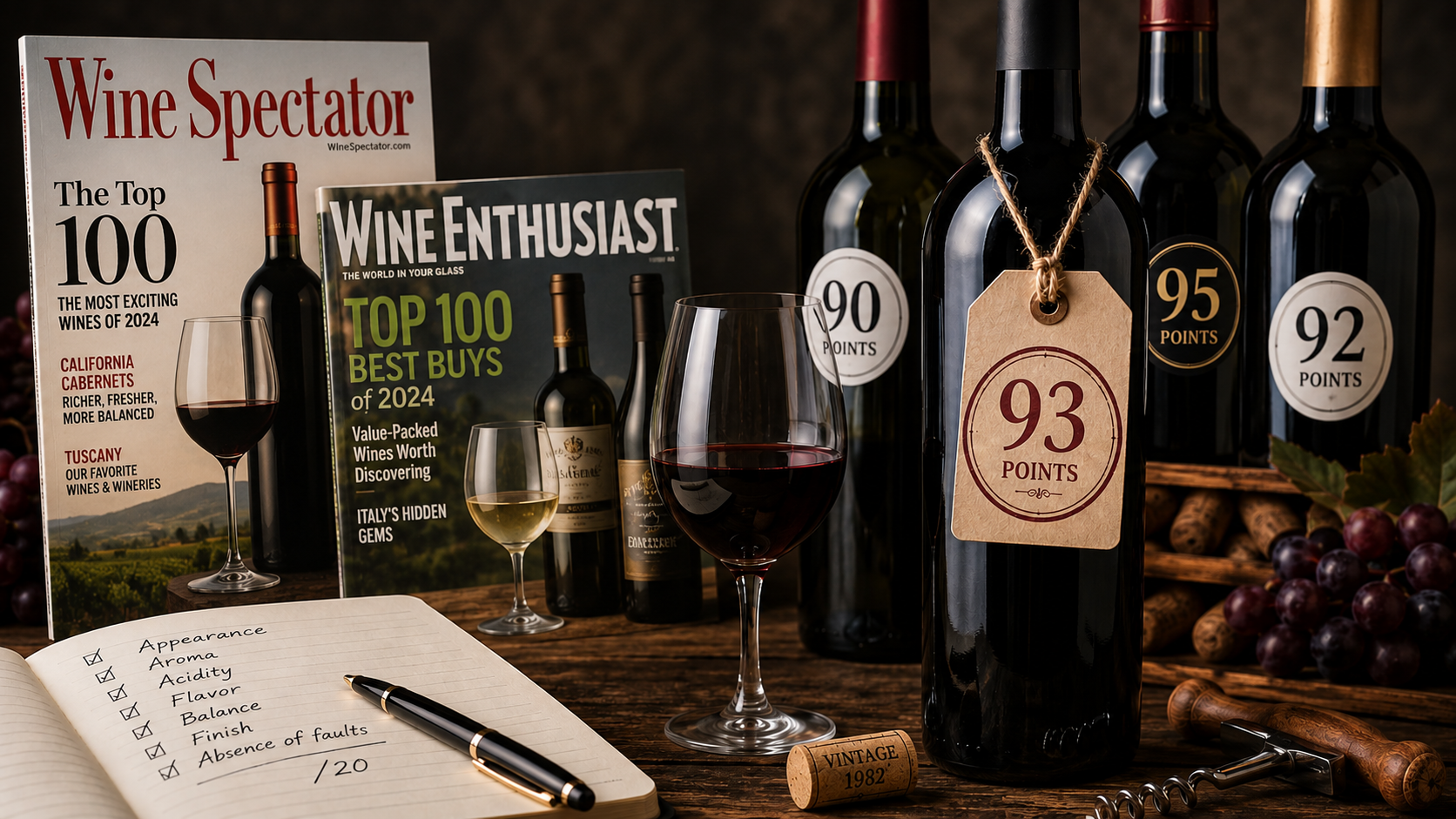
You see them everywhere – in advertisements, on store shelves, on tags hanging around the neck of bottles, and even on the bottle labels. Lately it seems like every wine is touting its 90 or 93 or 95-point score.
But what do these scores mean? And do they even matter?
While people have been writing about wine for a long time, point scores didn’t become popular until the late 1970s. Prior to that, wine writers would focus more on descriptions of wine. They would compare wines and make recommendations. This sometimes posed problems because some wine writers were actually hired by the wineries to write about their wines. Talk about a conflict of interest!
In the 1950s and 1960s, the first numerical system for judging wine was developed by researchers at the University of California Davis, and it used a 20-point rating scale. The interesting thing about it was that the scale used a deduction system, whereby each wine started with 20 points and points were deducted for various flaws. Wines were evaluated on:
- Appearance
- Aroma
- Acidity
- Flavor
- Balance
- Finish
- Absence of faults
Some wine competitions still use some variation of this system today.
Then along came Robert M. Parker, Jr.
Robert Parker was a lawyer and wine aficionado. He felt that the 20-point system was problematic – there wasn’t enough differentiation between wines and it was confusing for the average consumer.
So in 1978, he launched his own publication called The Wine Advocate and used a 100-point scale – the scale we’re familiar with to this day. The rating system caught on. Americans were drinking more wine and had access to a lot more imported wines. Plus, a simple numeric score was a lot easier to understand than several paragraphs of tasting notes.
What solidified Robert Parker’s reputation was the 1982 Bordeaux vintage. Many critics were skeptical of the quality of the vintage, but not Parker. He gave a number of high scores. As the wines matured, he was proven correct. His popularity soared. Suddenly, consumers paid close attention to Parker’s scores, retailers started advertising highly-scored wines, and wineries began seeking high scores for their wines.
Much like the movie Sideways influencing the California wine industry in a phenomenon now called the Sideways Effect, Robert Parker’s influence began to be called the Parker Effect.
In the 1990s, other publications like Wine Enthusiast and Wine Spectator began offering wine ratings on the 100-point scale as well. In fact, Wine Spectator currently rates more than 15,000 wines each year. And Wine Enthusiast annually rates over 24,000!
And now we see point scores everywhere.
But there are some problems.
Problem #1: As Robert Parker’s ratings became more popular, wineries began to change the way they made wine to appeal to his taste. He often favored fuller-bodied wines with higher tannin and alcohol, so more and more wines were being made in that style. And consumers who preferred a more restrained style were left with fewer options.
Problem #2: Today there are a variety of wine critics and publications making ratings and it’s not uncommon to see a wine have scores from multiple sources. The 1983 Chateau Mouton Rothschild (a highly sought-after wine) has – from different sources – a rating of 92, two ratings of 93, one rating of 94, and one rating of 18 (from someone still using the 20-point scale). So which one of these is correct? Your guess is as good as mine.
Problem #3: Robert Parker started his 100-point system partly because too many wines were getting the same score and there needed to be more differentiation. But challenge any critic to tell you the difference between a 91 and a 92, and I’ll bet you won’t get a clear answer.
Problem #4: Not all wines get rated. Sure, there are thousands each year that do but there are many more than that that don’t. Does that mean a non-rated wine is bad? Nope! I’ve had more than my fair share of fantastic wines that have never received a score.
Problem #5: There’s a little-known secret to Robert Parker’s 100-point scale: It starts at 50. The range is:
- 50-59 – unacceptable or seriously flawed
- 60-69 – below average
- 70-79 – average
- 80-89 – good or very good
- 90-95 – outstanding
- 96-100 – extraordinary
Problem #6: The average consumer doesn’t follow wine critics or read publications like Wine Spectator or Wine Enthusiast. So the only way they see wine scores is in advertisements, on store shelf promotions, or on the bottle itself. If a wine receives a low score, do you really think the winery marketing team is going to advertise that? When was the last time you saw a winery bragging about its 72-point wine?
So what should we do about point scores?
Honestly, whether you pay attention to them or not is completely up to you. A high score means someone or a group of tasters liked a wine. But that doesn’t necessarily mean you will like it.
If you’re someone who is inclined to rely on point scores, here are a couple tips:
- Get your information from an app like Vivino, which uses a five-star rating system. These ratings are from the millions of Vivino users who are regular consumers, so it is like asking a huge group of friends what they think about a particular wine. Vivino also has easy-to-understand descriptions of each wine to go along with the star ratings.
- Start to make a list of the wines you really like. If you were a wine critic, list the wines that you would rate highly. Once you’ve got ten to 15 wines on the list, start looking at critics’ websites and see which rate the ones on your list highly. Once you know that you’ve got a preference similar to a particular wine critic, you can feel more confident in their ratings. Here are a few to consider:
- Wine Spectator – www.winespectator.com
- Wine Enthusiast – www.wineenthusiast.com
- Robert Parker Wine Advocate – www.robertparker.com
- Jeb Dunnuck – www.jebdunnuck.com
- James Suckling – www.jamessuckling.com
- Jancis Robinson – www.jancisrobinson.com
Like them or not, point scores aren’t going away any time soon. It’s your choice to use them…or not.
What do you think? Leave me a comment with your opinion on point scores.



Leave a Reply