
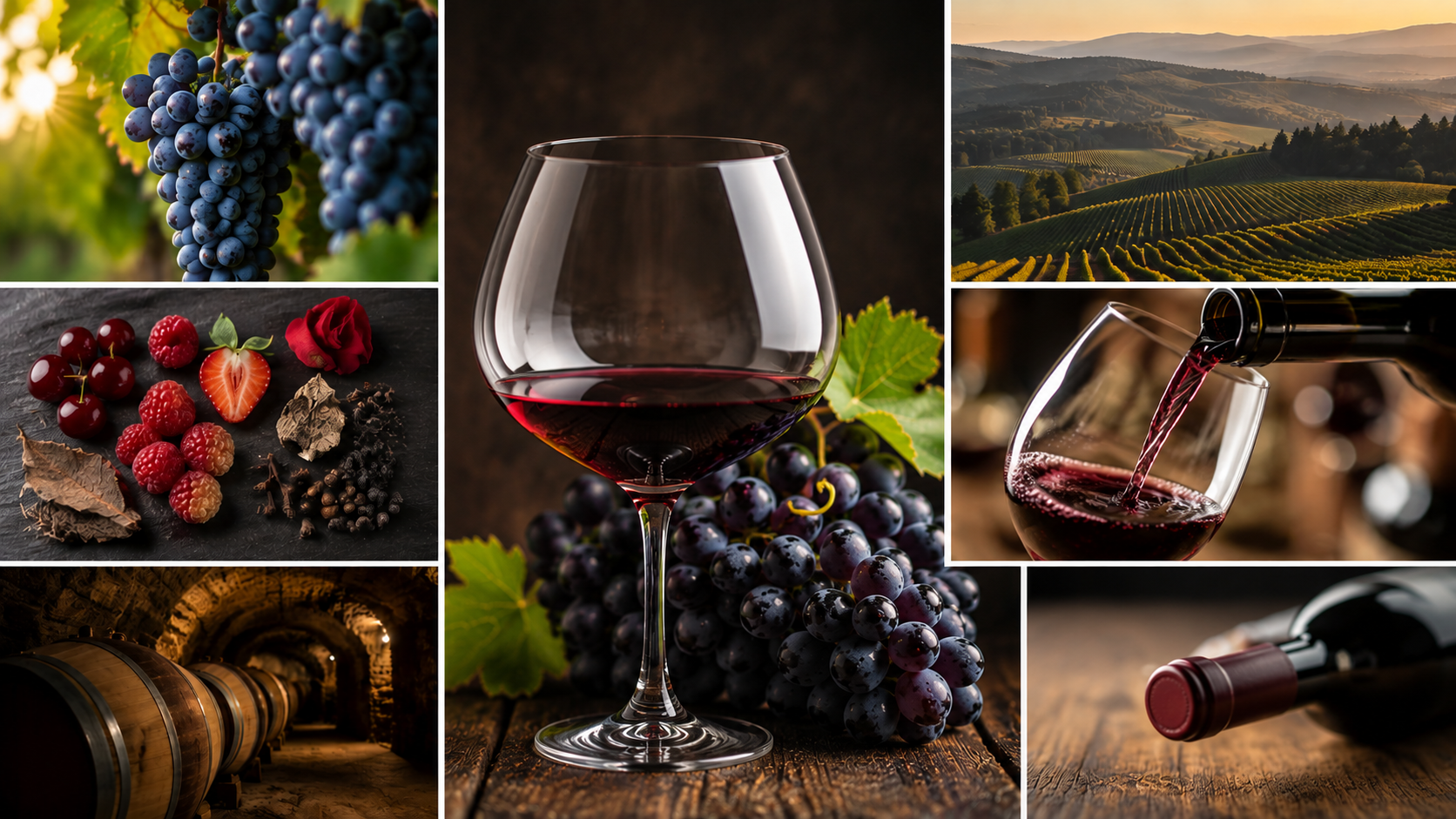
Would you pay $800,000 for a bottle of wine? Some people would…and one person did! Earlier this year, a bottle of 1945 Domaine de la Romanée-Conti sold at auction for $812,500. And what type of wine is that? Well, it was Pinot Noir, of course!
Pinot Noir is one of the world’s best-known grape varieties, and (depending on who you talk to) one of the world’s most interesting. It is difficult to grow. It can present different flavors based on where it is grown. It can be affordable or wildly expensive. And it took a movie to make it popular in the United States.
Rabbit Hole Alert!
This post contains several links to other Beyond the Glass posts so you can do a wine education deep dive. Have fun!
So pour yourself a glass and learn about this amazing grape.
Where does Pinot Noir Grow?
Winemakers often call Pinot Noir a “finicky” grape because it can be very difficult to grow. It has thin skin, is susceptible to disease, and requires a lot of work in the vineyard. It needs just the right conditions: a cool climate, low humidity, and big daily temperature shifts from warm days to cool nights.
When considering these conditions, it is no wonder that the best-known regions for Pinot Noir provide those exact conditions:
- Burgundy, France
- Sonoma/Russian River Valley, California
- Willamette Valley, Oregon
- Germany, where Pinot Noir is called Spatburgunder and is the country’s most widely planted red grape variety
- Central Otago, New Zealand
Pinot Noir also grows well in the Champagne region of France, where it is one of the three main grape varieties, along with Chardonnay and Pinot Meunier, used in Champagne. Pinot Noir and Chardonnay are besties. You can often find them growing together in the same regions because they tend to thrive in the same growing conditions.
What Does Pinot Noir Taste Like?
That depends on where it comes from.
There are certain characteristics that are fairly universal. Pinot Noir is a dry wine that is generally light to medium-bodied, so it is much lighter than a typical Cabernet Sauvignon, Malbec, or Rioja. Pinot Noir also tends to have low tannins, which means it will be smoother on your tongue.
But there are different qualities based on where the grapes are grown. And Pinot Noir is a great example of the differences between Old Word and New World. Old World (France, Germany) Pinot Noir tends to be a bit more restrained and has an earthy quality to it. New World Pinot Noir comes across as more fruit forward with brighter acidity.
I recommend trying a taste test. Get a bottle of Burgundy* and a bottle of Pinot Noir. Gather a few friends and taste the two bottles side by side. What similarities do you notice? What differences are there?
*Why isn’t Pinot Noir simply called Pinot Noir in France? Because in France, wine is named by location rather than by grape name, so it is called red Burgundy. You might find some bottles of Burgundy that actually do say Pinot Noir on the label. That’s more of a marketing tactic for those wines that are going to be exported to the US since many people don’t automatically know that red Burgundy wines are Pinot Noir.
What Food Should I Have with It?
Considering Pinot Noir’s lighter body, lower tannins, and higher acidity, you may want to consider foods like chicken, turkey, or salmon. Or a heartier vegetarian dish.
Why doesn’t Pinot Noir go with steak? Don’t most red wines pair well with red meat?
In this case, no. Steak is rich in protein and fat, so it needs a wine with higher tannins to pair well. And with Pinot Noir’s lighter body, a steak would overpower the wine. If the preparation of the beef is lighter, like a Filet Mignon or tenderloin, then a Pinot Noir could pair, especially an earthier Burgundy. But think of it this way:
- A grilled ribeye or brisket is a rock concert.
- Pinot Noir is an acoustic guitar; Cabernet Sauvignon is an electric guitar. Which one is the rock band going to use?
Often, Pinot Noir doesn’t need to be paired with food. As I write this, I’m enjoying a glass of California Pinot Noir on my balcony on a warm summer evening. No food. Just the wine.
The Sideways Effect
Pinot Noir was well-known to American wine enthusiasts but not so much to the average American consumer up until 2004 when the movie Sideways was released. Then everything changed. In the movie, the character Miles (played by Paul Giamatti) sings the praises of Pinot Noir while denigrating Merlot. In the few months after the film’s release, sales of Pinot Noir increased by 16%. Since then, plantings of Pinot Noir in California have increased 170% (while Merlot has dropped 35%) and Pinot Noir has become a household name. This type of industry and cultural shift caused by one cultural reference is now known as the Sideways Effect.
Why Is Some Burgundy Wine Affordable While Some is So Expensive?
Depending on where you shop for wine, it’s not uncommon to see bottles of Burgundy in the $200+ range, and even going up to four figures!
The main reason is simple supply and demand. The supply of wines from Burgundy is relatively small compared to regions like Bordeaux, and the vineyards are often quite small, divided up over the centuries by French inheritance laws.
- Tiny vineyards + difficult growing conditions = low production
- Low production + high demand = high prices
But there are also different classification levels that explain why some Burgundy wines are less than $30, some are above $75, and some are $200+. You’ll see these classifications on the bottle label.
- Burgundy (Bourgogne) is the basic level. Grapes can come from anywhere in Burgundy.
- The Village classification is the next level and indicates that the grapes come from a specific village in Burgundy.
- Premier Cru generally indicates one of the top vineyards in the village and when you start to see wines priced at over $60. Premier Cru is often shown as “1er Cru” on labels.
- Grand Cru is reserved for the top vineyards in the region. There are only 33 Burgundy Grand Crus, and it is tough to find a bottle priced less than $150.
Let’s make the analogy to real estate to make this easier to understand. If you were going to buy a home…
- Burgundy/Bourgogne would be a home in the greater Washington DC Metropolitan area.
- Village would be in the city of Washington, DC.
- Premier Cru would be in a desirable neighborhood of Washington, DC.
- Grand Cru would be on the most desirable street in a desirable neighborhood in Washington, DC.
That’s why a Grand Cru can command such high prices.
Speaking of high prices, remember that $812,500 bottle of Pinot Noir? At that price, that comes to about $54 per drop of wine.
Now that’s a wine to savor!
If you’re not yet subscribed to Beyond the Glass, scroll down to subscribe today. You’ll get new blog posts sent directly to your inbox.



Leave a Reply