
What could be more festive than popping open a bottle of bubbles? Whether it’s Champagne at a wedding, Prosecco at brunch, or a sparkling rosé on a warm summer evening, those shimmering bubbles instantly make any occasion feel special.
But have you ever wondered where those bubbles actually come from?
Sparkling wine doesn’t come out of the grape naturally fizzy. In fact, every sparkling wine begins life as a still wine. The bubbles are created through a carefully-controlled winemaking process.
The result is one of the most fascinating and technically challenging styles of wine to produce. Understanding those challenges can also explain why some sparkling wines cost significantly more than others.
Let’s take a closer look at how winemakers turn still wine into a bottle full of bubbles and learn some sparkling wine terminology along the way.
The Basic Science of Bubbles
At its core, sparkling wine is simply wine that contains dissolved carbon dioxide gas. When you remove the cork to pour a glass, the pressure inside the bottle drops dramatically and the dissolved gas escapes and rises to the surface in the form of bubbles.
You see the same principle at work when you open a can of soda.
The carbon dioxide itself is created naturally during fermentation. Yeast consumes sugar and converts it into alcohol and carbon dioxide. During the production of still wine, the carbon dioxide is allowed to escape into the atmosphere. In sparking wine production, however, winemakers intentionally trap the gas so it remains dissolved in the wine.
The trapped bubbles are what make sparkling wines sparkle.
Step One: Make the Base Wine
Before sparkling wine becomes sparkling, it starts as an ordinary still wine known as the base wine.
The grapes used for sparkling wine are often harvested earlier than grapes intended for still wine which helps preserve the acidity while keeping sugar levels relatively low.
Why does that matter?
Acidity gives sparkling wine its freshness and vibrancy. Without enough acidity, sparkling wine can taste flat and heavy rather than crisp and refreshing.
The three most common grape varieties used in sparkling wine production are Chardonnay, Pinot Noir, and Pinot Meunier. These are the three classic grapes of Champagne, though sparkling wines around the world use other varieties as well.
Interestingly, the base wine usually doesn’t taste particularly exciting on its own. It might seem tart and rather simple. That’s because it isn’t intended to be consumed at this stage. The magic happens during the next steps.
The Traditional Method: The Gold Standard
The most famous method of producing sparkling wine is known as the Traditional Method, sometimes called the Methode Traditionnelle or the Champagne Method. This is the process used in Champagne and by many premium sparkling wine producers around the world.
Step 2: Blending the Wine and Adding the Tirage
Before the bubbles are created, winemakers often blend different wines together. They might combine:
- Different grape varieties
- Different vineyard sites
- Different vintages
Blending allows producers to create a consistent house style year after year.
Once the blend is finalized, the wine is bottled and a mixture called the tirage is added. The tirage typically contains yeast and sugar. This small addition triggers a second fermentation inside the bottle. At this stage, a temporary cap is put on the bottle that will eventually be removed and replaced with the cork.
Step 3: The Second Fermentation
The second fermentation is where the bubbles are created.
Just like the first fermentation, the yeast consumes the added sugar and produces additional alcohol and carbon dioxide. But unlike the first fermentation, the bottle is sealed, and because the carbon dioxide has no place to go, it becomes trapped in the wine.
As pressure builds, the gas dissolves into the liquid. When the bottle is eventually opened months or sometimes years later, that dissolved gas is released as the familiar stream of bubbles.
Step 4: Aging on the Lees
After the second fermentation is done, the yeast cells die and settle to the bottom of the bottle. These dead yeast cells are called lees.
Rather than removing them immediately, many producers allow the wine to age having contact with the lees, known as aging on the lees. This aging process with lees contact contributes some of the flavors that sparkling wine lovers often seek:
- Brioche
- Toast
- Bread dough
- Biscuit
The longer the wine ages on the lees, the more complex these flavors can become.
Some sparkling wines spend only a few months aging. Premium wines from top producers might age for many years before release.
Step 5: Removing the Sediment
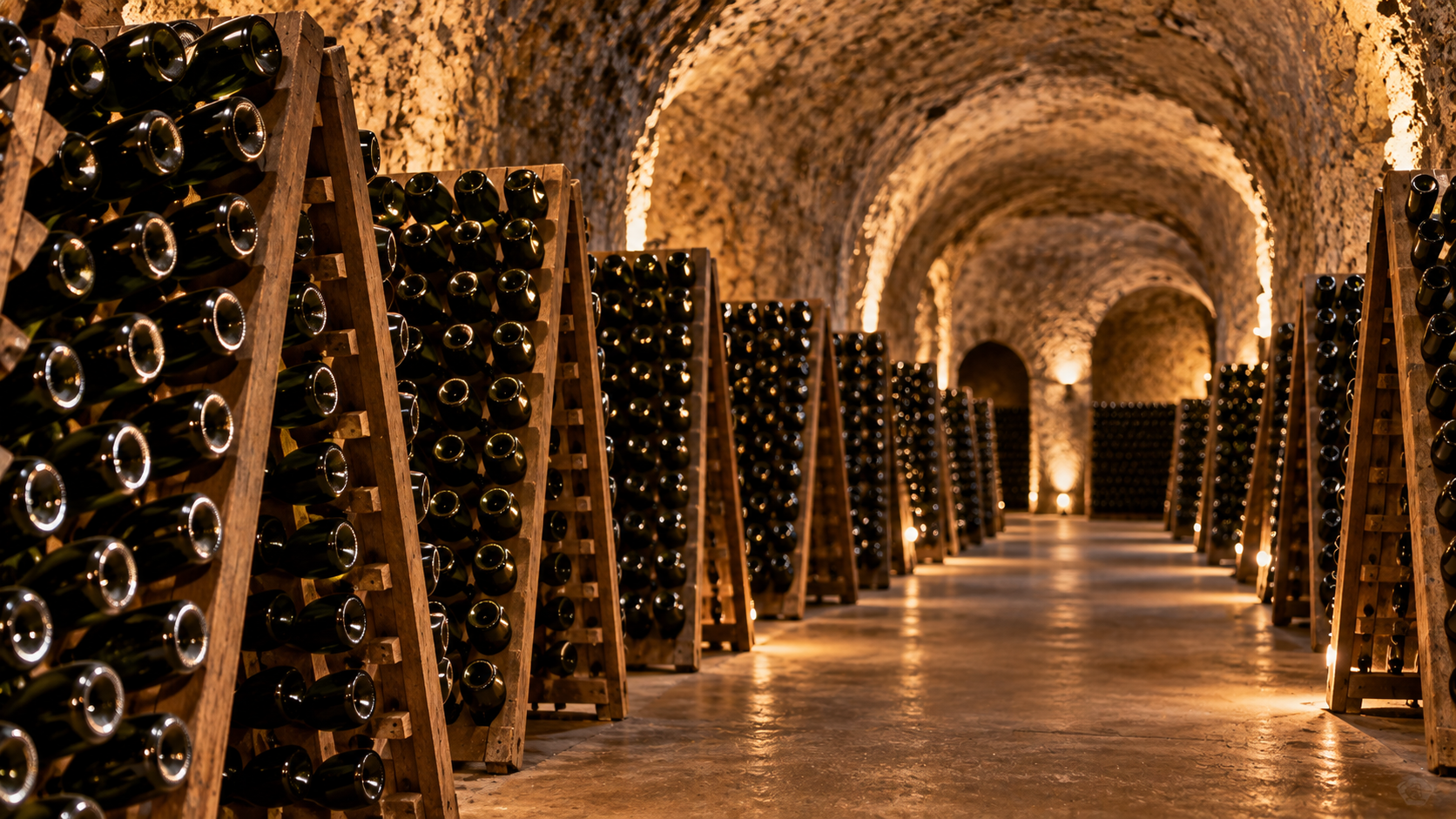
Eventually the yeast sediment must be removed from the bottle. This process begins with riddling.
Traditionally, bottles have been placed neck down in wooden racks and rotated slightly every day. Over time, the sediment gradually collects in the neck of the bottle. Today, many wineries use automated machines to perform the same task more efficiently.
Once all the sediment has gathered in the neck, the bottle undergoes disgorgement. The next of the bottle is frozen, trapping the sediment inside a small plug of ice. When the temporary cap is removed, the pressure inside the bottle ejects the frozen plug, leaving behind clear sparkling wine.
Step 5: Dosage
After disgorgement, a small amount of wine is added back into the bottle to replace what was lost during the sediment removal process. This addition is known as dosage.
The dosage might contain sugar, depending on the style the producer wants to create. The amount of sugar added determines terms you might see on labels, such as:
- Brut Nature – bone dry, very crisp, no noticeable sweetness
- Extra Brut – very dry, slightly softer than Brut Nature
- Brut – dry and balanced, the most common type of Champagne and sparkling wine
- Extra Dry – slightly off-dry, sweeter than Brut
- Demi-Sec – noticeably sweet
Despite the name, “Extra Dry” is actually sweeter than “Brut.”
Once the dosage is added, the bottle receives its final cork and wire cage and is ready for sale.
Other Ways to Make Sparkling Wine
Not all sparkling wine is produced using the Traditional Method.
The Tank Method, also known as the Charmat Method, is commonly used for Prosecco. Instead of carrying out the second fermentation in individual bottles, producers conduct it in large pressurized tanks. The wine is then bottled under pressure.
This approach is faster and less expensive than the Traditional Method while preserving fresh fruit flavors and floral aromas, which is one reason why Prosecco often tastes lighter and more fruit forward than Champagne.
The simplest and least expensive method involves directly injecting carbon dioxide into the wine. This is essentially the same process used to carbonate soft drinks. While acceptable for some products, carbonated sparkling wines generally have larger bubbles and less complexity than wines produced through secondary fermentation.
Bubbles in wine are created by the intersection of science and tradition. Whether the wine is made using the Traditional Method, the Tank Method, or some other approach, the production process has a major impact on its flavor, texture, and complexity.
So the next time you hear the pop of a cork and watch those bubbles race to the surface, you’ll know exactly how they got there. And why so much work went into creating them.

Leave a Reply